Shannon Taylor
CEO/Publisher
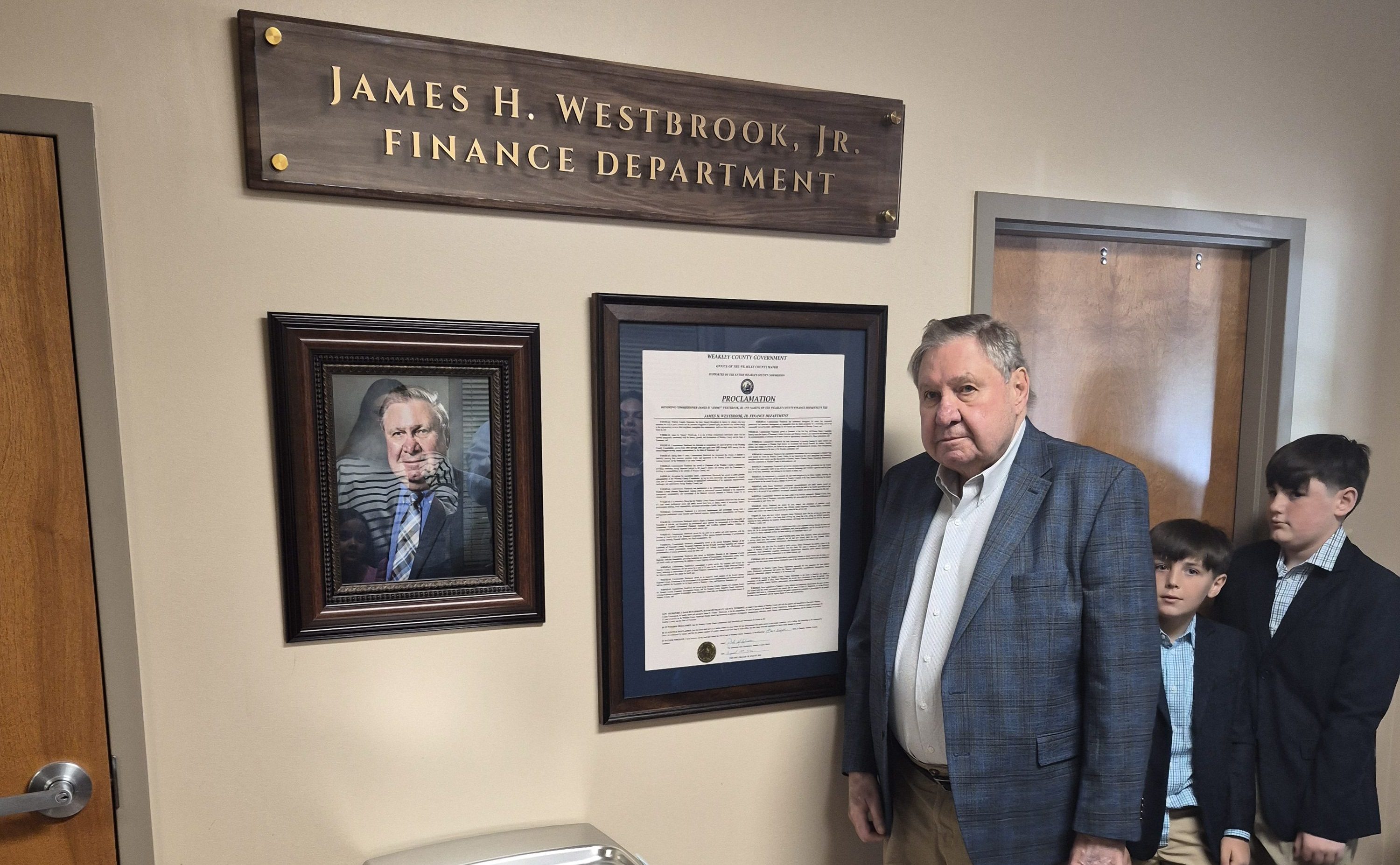
For decades, Jimmy Westbrook has been a familiar presence in Weakley County government, offering advice, questioning expenditures, helping shape public policy and working behind the scenes on projects that have changed the county. On October 8, county officials, colleagues, friends and family gathered to recognize that service with a dedication that will permanently place his name in the Weakley County Finance Department.
The ceremony brought together people who have worked alongside Westbrook through different generations of county leadership, with speakers recalling not only his contributions to government but also the relationships, habits and personal influence that have made him a recognizable figure in courthouse meetings and county offices.
Weakley County Mayor Dale Hutcherson opened the ceremony before Finance Director John Liggett, former County Mayor Jake Bynum and Westbrook himself addressed those gathered. The program concluded with the dedication and unveiling of the tribute honoring Westbrook in the Finance Department.
Liggett spoke about the influence Westbrook has had on county government and the people responsible for managing its finances. He said he would miss Westbrook’s knowledge, expertise and willingness to help with the many issues that arise in public administration, describing their working relationship as an honor.
For Liggett, the dedication represented more than recognition of a longtime public official. He explained that Westbrook’s influence could be found throughout the county’s policies, procedures and everyday operations, particularly in the offices responsible for handling public money.
“He’s got his fingerprints on the culture in this county, and particularly in the government offices,” Liggett said.
Liggett reflected on his years as finance director and the guidance Westbrook had provided throughout that time. Although Westbrook’s name would now be associated with the department, Liggett said his contributions extended well beyond the dedication itself.
“Leadership is not measured in titles; it is measured in impact,” Liggett said, adding that he could think of no one who had demonstrated greater leadership and influence in Weakley County than Westbrook.
Former County Mayor Jake Bynum followed with a more personal reflection, explaining that Westbrook had been part of his life since childhood. Bynum recalled attending church with his grandmother, Jane, who sat behind Westbrook and his wife, Donna. The two women would arrive early and discuss the week’s events while Westbrook, according to Bynum, frequently appeared just before the service began, newspaper in hand.
Bynum said he never imagined those childhood memories would eventually lead to a close working relationship with Westbrook during his own time as county mayor. He joked that Westbrook probably never expected him to be elected to the office, drawing laughter as he described the longtime commissioner’s personality and approach to government.
Among the habits Bynum remembered was Westbrook’s tendency to open a newspaper during meetings, sometimes appearing more interested in reading than listening. Bynum said those who worked with him knew better, explaining that Westbrook could follow the discussion, retain the information being presented and possibly complete a crossword puzzle at the same time.
He also recalled Westbrook beginning telephone conversations by insisting he was not trying to tell anyone what to do, even when he had a very specific idea about how something should be handled. Another familiar phrase, Bynum said, was Westbrook’s assurance that there was no hurry, sometimes followed by another call only 20 minutes later asking whether the matter had been resolved.
Beyond those personal memories, Bynum described Westbrook as a builder whose influence could be seen in physical facilities, government programs and public policies throughout Weakley County.
He pointed to renovations of the courthouse, additions at the Highway Department, improvements involving the electric company and the building now occupied by county education and finance offices. Bynum also mentioned the Health Department, Election Commission and the county’s schools, noting that Westbrook had participated in decisions affecting school construction and improvements over many years.
But Bynum said Westbrook’s contributions were not limited to buildings. He credited him with helping develop the county’s emergency communications system, supporting the regional airport partnership and promoting economic development efforts that brought additional opportunities to local communities.
Bynum also discussed Westbrook’s involvement in tax increment financing, commonly known as TIF, and cited commercial development projects in Martin and Greenfield as examples of initiatives Westbrook supported.
He pointed to improvements at the University of Tennessee at Martin, including the Champions Club and press box at the football stadium, and described Westbrook’s influence on organizations serving county officials across Tennessee.
One of the most consequential contributions, Bynum said, was Westbrook’s support for centralized financial management under Tennessee’s Financial Management System of 1981.
The system established a framework for coordinating county financial operations, including purchasing, accounting and budgeting. Bynum said Westbrook’s advocacy for centralized finance helped shape how Weakley County manages public funds today.


Bynum also recognized Westbrook’s family, explaining that the values reflected in his public service could be seen in his children, grandchildren and great-grandchildren.
He described Westbrook as someone whose work would benefit people long after his own time in office, comparing his contributions to planting trees that future generations would enjoy.
Following Bynum’s remarks, those attending viewed a video message from a representative of the County Technical Assistance Service, an organization with which Westbrook has maintained a longstanding connection through his work in county government.
Hutcherson then offered his own reflections, describing Westbrook as someone whose influence reached far beyond Weakley County.
He recalled that when he decided to seek public office, his grandfather warned him about the difficulties of politics but advised him to listen carefully to Westbrook.
Hutcherson said that advice proved valuable as he began serving as county mayor and came to understand the extent of Westbrook’s experience and relationships throughout Tennessee.
“Your impact rings true, literally from Bristol to Memphis, from our corner of the state to Chattanooga and in Nashville,” Hutcherson told Westbrook.
Hutcherson also recognized Westbrook’s family, describing the example he had set for his children, grandchildren and great-grandchildren as one of his most lasting contributions.
He thanked Westbrook for his guidance and for helping establish a foundation that future county leaders could build upon.
“You will forever be cemented on our finance department,” Hutcherson said, praising Westbrook’s stewardship of taxpayer dollars and his service to the people of Weakley County.
When Westbrook was invited to speak, he admitted that he had not expected such a gathering and joked that he had told someone there probably would not be many people in attendance.
Rather than dwell on the praise he had received, Westbrook used the opportunity to tell a story about the building where the ceremony was taking place.
He recalled receiving a telephone call from Ned McWherter, who was preparing to construct a new distribution facility and offered to deed the existing building to Weakley County.
At the time, Westbrook explained, the county school system’s administrative offices were scattered throughout the courthouse, occupying portions of the third floor and other available spaces. The arrangement was difficult, but it reflected the limited facilities available to county officials.
Westbrook said McWherter’s offer provided an opportunity to bring those offices together in one location, creating a more practical arrangement for the school system and other county operations.
He was careful to explain that he had not personally financed the project and did not want to take credit for contributions made by others.
“I didn’t contribute one dime to it, and I’m not taking any credit like that,” Westbrook said.
He also reminded those attending that although speakers had credited him with helping bring numerous projects to completion, he had not personally constructed the buildings they mentioned.
Instead, Westbrook thanked those who organized the dedication and expressed appreciation for the friendship and support he had received throughout his years in public service.
“I appreciate your company, appreciate your friendship and support down through the years,” he told the gathering.
The ceremony concluded with the dedication and unveiling of the tribute in the Finance Department. Family members, county officials and friends gathered for photographs as Westbrook stood beside the recognition that will remain in the department bearing his name.
For those who spoke, the dedication was an acknowledgment of work that has shaped Weakley County government over many years, from financial procedures and public facilities to the relationships between the people responsible for carrying out county business. Westbrook’s name will now remain a permanent part of the department whose operations he helped influence, while the policies, projects and institutions discussed during the ceremony continue to serve the county.
Make a one-time donation
Make a monthly donation
Make a yearly donation
Choose an amount
Or enter a custom amount
Your contribution is appreciated.
Your contribution is appreciated.
Your contribution is appreciated.
Leave a Reply