Shannon Taylor
CEO/Publisher
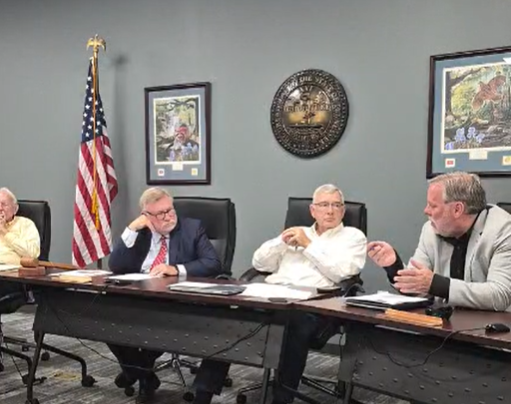
Dresden remains without specific zoning regulations governing data centers after the town’s Planning Commission spent more than an hour October 8 examining the potential effects of the facilities on water supplies, electricity, surrounding properties and local taxpayers. Although commissioners discussed the possibility of temporarily restricting development while they worked on an ordinance, the meeting ended without a recommendation to impose a moratorium or adopt new regulations.
The discussion followed an August 27 meeting when the board began considering how data centers, including large-scale facilities and smaller cryptocurrency operations, should be regulated within town limits. At that time, members agreed additional research and public input were needed before moving forward with an ordinance.
The October meeting brought representatives from the Dresden Water and Sewer Department, Weakley County Municipal Electric System and local economic development officials to address questions about whether the town has the infrastructure to accommodate such facilities and what financial benefits or obligations might accompany them.
One of the central concerns was how quickly a facility could locate in Dresden before regulations are adopted. During the meeting, officials explained that under the town’s existing zoning provisions, a data center could potentially be treated as an industrial or manufacturing use on property already zoned for industrial development.
That possibility became particularly relevant as commissioners discussed existing buildings in Dresden’s industrial areas that could potentially be converted for data center operations.
Justin Crice, executive director of the Weakley County Economic Development Board, presented information about the potential financial benefits of such facilities while questioning whether some of the proposed zoning restrictions would unnecessarily limit the use of existing industrial buildings.
Crice discussed a hypothetical investment of $100 million in computer equipment and other taxable personal property. Using Dresden’s property tax rate of $1.27, he estimated the investment could generate approximately $190,000 in annual municipal property tax revenue, with additional revenue of more than $230,000 for Weakley County. Those figures were presented as an illustration of potential tax revenue, not as projections for an identified development.
He also emphasized that economic development officials are not actively recruiting data centers and do not recommend offering tax abatements to attract them.
Crice described the facilities primarily as potential sources of tax revenue rather than traditional economic development projects, noting that they do not necessarily produce the number of jobs associated with manufacturing operations.
The proposed zoning ordinance discussed in August would restrict data centers to M-2 Heavy Industrial districts and establish additional requirements involving property size, setbacks, landscaping, noise and utility impacts.
However, Crice raised concerns about applying those requirements to buildings that already exist in Dresden’s industrial areas.
He identified a seven-acre industrial property containing a roughly 50,000-square-foot building and discussed another large industrial building on Evergreen Street occupied by Champion Homes and CSS USA. He explained that existing structures might not satisfy all the proposed setbacks or landscaping requirements even though they are already located in areas intended for industrial activity.
Planning consultant Donny Bunton responded that he had developed possible language exempting existing structures from certain property-line setback requirements, provided they still maintained the required distance from nearby residential dwellings.
The discussion included proposed residential buffers of 500 feet or 1,000 feet, depending on the type of facility, as well as property-line setbacks of 100 feet for data centers and 200 feet for hyperscale operations.
Bunton also suggested that exceptions could be considered for landscaping requirements when existing buildings have insufficient space or utilities occupy areas where landscaping would otherwise be required.
Those changes were discussed as possible revisions to the proposed ordinance. They were not adopted during the meeting.
Water consumption was another major concern, particularly whether Dresden could accommodate a facility without affecting existing residential and commercial customers.
Josh Lassiter, representing Dresden’s water and sewer operations, explained that the town’s water treatment plant has a production capacity of approximately 2 million gallons per day and currently produces between 550,000 and 600,000 gallons daily.
Lassiter said a facility consuming 20,000 gallons per day could be supplied through the existing system without placing a significant strain on the water plant or wastewater infrastructure.
He also described a retention basin on industrial property near Swanson Street, across from FedEx, that could potentially provide another water source for certain operations.
However, the discussion did not establish that every type of data center, particularly a large hyperscale facility, would consume no more than 20,000 gallons daily.
Crice said he had heard from a utility provider at a recent economic development conference that some newer data centers using more efficient cooling systems could consume fewer than 1,000 gallons daily. Other estimates discussed during the meeting ranged considerably higher.
Commissioners also questioned the difference between closed-loop cooling systems and systems that continuously require additional water.
Lassiter explained that Dresden does not currently operate a reclaimed-water system like those available in some larger municipalities. A developer wanting to use reclaimed water would therefore need to make separate arrangements rather than rely on an existing municipal supply.
While Lassiter expressed confidence in Dresden’s ability to serve a facility with the consumption figures discussed, no engineering study for a specific proposed data center was presented.
Electricity requirements produced another lengthy discussion.
The general manager of Weakley County Municipal Electric System explained that the Tennessee Valley Authority implemented new requirements for data centers effective October 1, including provisions addressing electrical demand, feasibility studies, upfront payments and system improvements.
She said the ability to serve a data center would depend on its location and electricity requirements.
A smaller facility requiring less than five megawatts could potentially be accommodated through existing infrastructure in Dresden’s industrial area, although additional equipment or a dedicated electrical circuit might be necessary.
Larger operations could require substantial upgrades, additional review and approval through TVA.
The utility representative explained that Dresden’s industrial area has advantages because of its proximity to existing electrical infrastructure, including a substation near the railroad tracks. She said the system could potentially accommodate additional demand through upgrades, but equipment procurement and construction could take time.
The board repeatedly questioned whether local electric customers would be required to pay for improvements needed to serve a new facility.
The utility representative said she believed the developer should be responsible for those costs, particularly because data centers generally do not provide the same employment benefits as other large industrial customers.
Bunting explained that the proposed zoning language already included a provision requiring developers to pay for necessary utility improvements identified through a utility impact analysis.
The board expressed support for protecting existing customers from costs associated with a private development, but the meeting did not establish the precise financial terms that would apply to any future project.
Several residents also addressed the commission.
Robert Gaylord, who said he lives outside Palmersville, raised concerns about water and electricity consumption and questioned the business practices associated with collecting and storing personal data.
His comments reflected concerns about privacy and the possible effects of large electrical demands on existing customers. The discussion did not establish that a proposed Dresden facility would collect or sell residents’ personal information.
Chase Gaylord expressed concern about noise and its potential effects on wildlife, particularly deer, turkey and other animals hunted by local residents who use wild game to supplement their household food supplies.
The board later returned to that question, discussing whether existing environmental regulations or proposed noise limits would address the effects of continuous mechanical noise on wildlife.
Officials acknowledged that the proposed zoning ordinance did not specifically address hunting or wildlife impacts and that they did not have information establishing what effects a data center’s noise might have on nearby animals.
Dave Chambliss, who lives on Evergreen Street near industrially zoned property, urged the commission to move more quickly.
Chambliss argued that the town needed to recognize differences between smaller cryptocurrency facilities and much larger hyperscale data centers because their infrastructure requirements and potential environmental effects could vary substantially.
He also raised questions about cooling-system chemicals, wastewater handling and the importance of establishing enforceable standards before a developer seeks approval.
Chambliss warned that without regulations in place, the town could find itself responding to a development proposal under existing zoning provisions that were not written with data centers in mind.
He encouraged commissioners to adopt an ordinance as soon as possible and amend it later if additional protections became necessary.
As the meeting moved toward its conclusion, commissioners discussed whether they could recommend an immediate, limited zoning amendment restricting data centers to M-2 Heavy Industrial property while continuing to work on more detailed regulations.
Bunton explained that such a restriction would still require a formal zoning amendment and action by the Board of Mayor and Aldermen.
Another possibility was a temporary moratorium on data center development.
Bunton explained that some municipalities have adopted time-limited moratoriums while studying new land uses. He suggested that a six-month moratorium could be considered, but said the authority to adopt one would rest with the city board rather than the Planning Commission.
He also cautioned that timing could become important if a developer submitted an application before new restrictions were enacted.
Despite those discussions, commissioners did not recommend a moratorium or approve an interim zoning amendment.
Instead, the commission agreed to allow additional time for revisions to the proposed ordinance, using the recently released Municipal Technical Advisory Service guidance and the concerns raised during the meeting.
Officials discussed preparing a revised ordinance for the commission’s regularly scheduled October 29 meeting at noon, with the goal of advancing a recommendation to the Board of Mayor and Aldermen in November.
The discussion also acknowledged that a zoning ordinance would require two readings by the city board before becoming effective.
The board were told that no specific company had publicly expressed interest in developing a data center in Dresden, although the discussion did not establish whether any private inquiries or preliminary conversations had occurred outside the commission.
For now, the town’s approach remains under development.
The commission has examined possible restrictions on where facilities could locate, how close they could operate to residential property, how much noise they could generate and who would pay for utility improvements. It has also considered exceptions that would make existing industrial buildings easier to use for data center operations.
What remains unresolved is which protections will ultimately be included, whether the town will impose temporary restrictions before adopting a permanent ordinance and how the proposed regulations will address the substantial differences between smaller facilities and large hyperscale developments.
The Planning Commission is scheduled to return to the issue October 29, when members are expected to consider revised ordinance language. Until then, Dresden has not adopted the data center-specific restrictions discussed at either meeting.
Make a one-time donation
Make a monthly donation
Make a yearly donation
Choose an amount
Or enter a custom amount
Your contribution is appreciated.
Your contribution is appreciated.
Your contribution is appreciated.
Leave a Reply