Shannon Taylor
CEO/Publisher
What began less than a year ago as an effort to help a few dozen people each week has quickly outgrown its space.
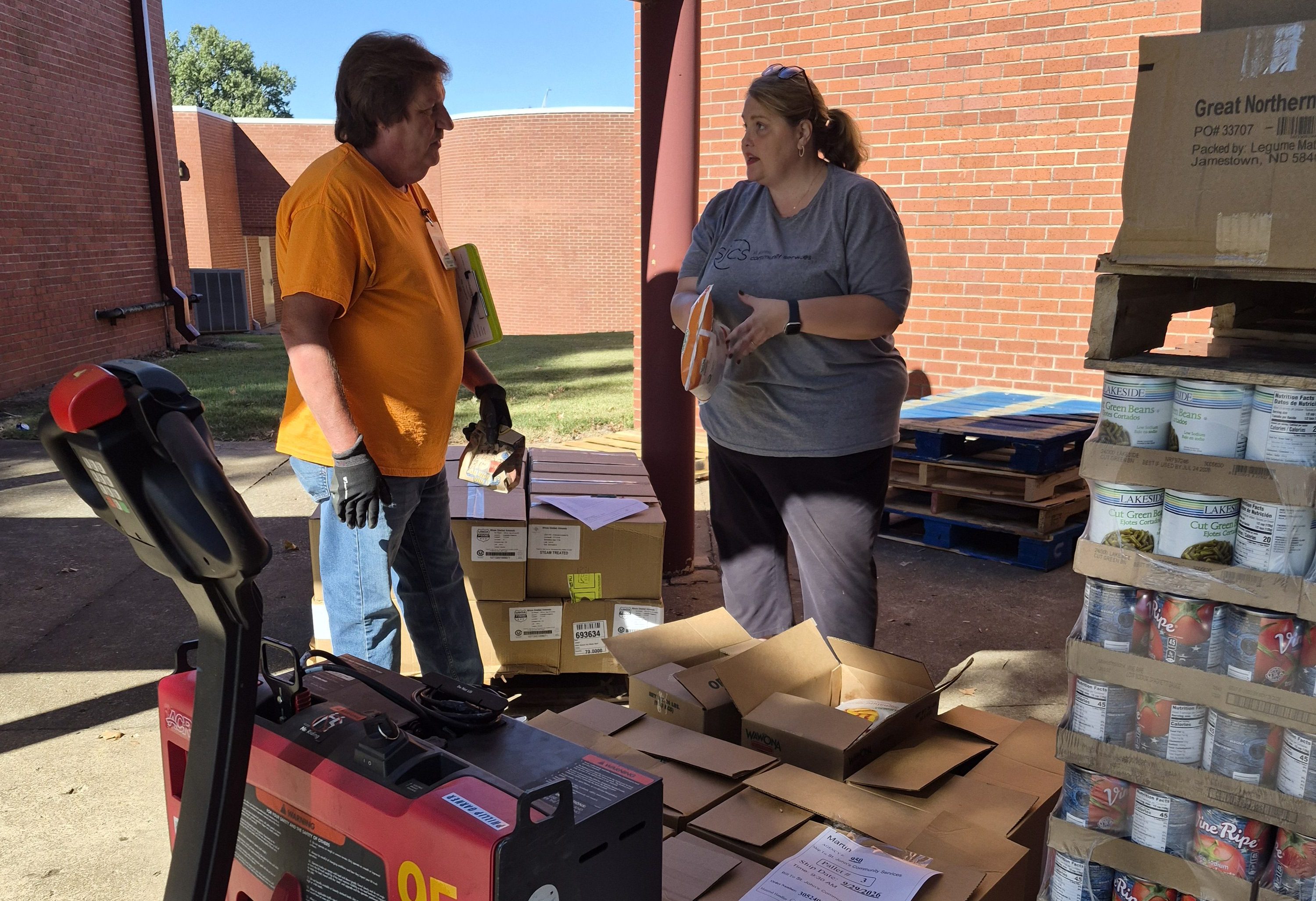
Every Tuesday, people begin arriving at The Pantry, a program operated by St. John’s Community Services in Martin. Some need groceries. Others may need clothing, household items or simply a little help making it through another week.
When The Pantry opened last October, it was helping approximately 20 to 30 people each week. Today, the program provides food for more than 300 people weekly, and those behind it are working to find the space, volunteers, financial support and community partnerships necessary to keep pace with the need.
“Our mission is that we believe that every person, regardless of abilities or circumstances, deserves the support of a loving community,” Mandy Hinson said.
Hinson works in marketing for St. John’s, but on Mondays and Tuesdays, much of her time is spent inside The Pantry alongside a small group of volunteers preparing for and operating the weekly distribution.
The Pantry is open each Tuesday from noon until 3 p.m. and operates differently from many traditional food distribution programs. Rather than receiving a prepacked box containing whatever happens to be available, visitors are given an opportunity to shop.


The program operates as a choice food pantry, allowing people to select items they actually want and will use. Households of two people or fewer may select 25 nonperishable items in addition to perishable foods that are available, while households of three or more may select 45 nonperishable items, along with available perishable foods.
For Hinson, providing that choice is part of preserving dignity for people who may already be struggling.
“My goal is just for everybody to feel welcome, loved, leave with dignity, because it’s hard,” Hinson said. “I’ve never been hungry. I don’t know what it’s like.”
Approximately 100 individuals may physically come through The Pantry during a weekly distribution, but the groceries they take home help feed more than 300 members of their households.
The Pantry is a USDA food pantry, meaning certain federal requirements apply to USDA-provided food. Income information is self-reported, and Tennessee residency is required to receive USDA food. Hinson said, however, the pantry does not intend to turn away someone who comes through the door needing help.
“We’re going to help everybody that comes through,” she said.
Food is only part of what has developed inside the program.
The Pantry also maintains clothing, children’s items, cookware, bedding, toys, furniture and other necessities that can help families and individuals, including people experiencing homelessness. Donations have poured in so quickly that space has become a problem of its own. Hinson has temporarily slowed most clothing donations because there is simply nowhere to put everything while the organization works toward moving into a larger facility.
The Pantry’s work also depends heavily on community partnerships. Hinson said Second Harvest Food Bank, Walmart in Martin and the Dollar General on Regina Street in Martin are among the program’s largest partners and have played a major role in making the weekly food distribution possible. Other partnerships have helped bring clothing and additional necessities into the program from businesses across the region.
The need for food and other necessities, however, continues.
The Pantry’s rapid growth has created one of its biggest challenges. It has outgrown its current location.
Hinson is working to raise $20,000 to move the program into a larger warehouse near Stanley Black & Decker. Approximately $4,000 had been raised toward that goal at the time of the interview.
A larger facility would provide additional room for food, clothing and household necessities while giving volunteers more room to work. Hinson also hopes the additional space could eventually allow The Pantry to open more days and reach more people.
Fundraising efforts specifically supporting the pantry and its move include percentage-of-sales partnerships with area restaurants and Music in the Vines.
St. John’s Community Services will also hold its annual Radiothon Nov. 12, but that fundraiser has a broader purpose. Rather than serving as a fundraiser for The Pantry’s move, Radiothon primarily supports the other services St. John’s provides to people with intellectual and developmental disabilities and others served through its programs.
Financial contributions are important, but money and space are not the only things The Pantry needs. Volunteers are needed on Mondays, particularly from 9 to 11 a.m., as the pantry prepares for the following day’s distribution. Additional help is needed on Tuesdays as volunteers stock shelves, organize food, assist shoppers and handle the steady flow of people coming through the doors.
The Pantry relies heavily on its volunteers, and some of those volunteers know firsthand what it means to need the kind of help they now provide.
Otis Crayton was once homeless and later found himself coming to The Pantry for food. After receiving help himself, he decided it was time to give something back.
“I always said, if I ever get on my feet, I’d like to do something like this,” Crayton said.
He has now volunteered at The Pantry for several months.
“This is my pride and joy,” he said.
For Crayton, the work is personal. He sees families with children, elderly residents and people experiencing homelessness come through the doors each week.
“You see a lot of homeless people out here. You see people that got kids that can’t feed them,” Crayton said. “It makes me feel good. It touches my heart.”
Sometimes, he said, it makes him emotional. His favorite part is simple: handing someone food and watching that person smile.
“We need to take care of each other,” Crayton said. “This is what we should be like, trying to help each other, make sure they have something, because we don’t know where we’re going to end up at.”
College students are beginning to become part of that effort as well.
St. John’s has developed partnerships with student organizations at the University of Tennessee at Martin, and students have helped stock shelves, organize donations and distribute food. During one recent volunteer event, approximately 50 students spent time helping at The Pantry.
Hayden Moon, a UTM student and member of Pi Kappa Alpha, recently began volunteering after his fraternity looked for additional opportunities to serve the community.
Moon said the organization was already involved with the Backpack Club in Dresden but wanted another opportunity to help more frequently.
“People are out there hungry,” Moon said. “Everybody’s working real hard to help them out.”
What stood out to him was how little idle time there was inside The Pantry.
“There’s no sitting around,” Moon said. “Everybody’s doing something.”
Hinson hopes more individuals, churches, civic groups, businesses and other organizations will join them, and one of the most pressing needs involves something many people may never consider when thinking about food insecurity: transportation.
Hinson regularly receives messages from people who need food but have no way to get to The Pantry. Volunteers attempt to make deliveries when possible, but the same small group has already spent hours receiving food, stocking shelves, organizing donations and serving families. By the end of a distribution day, they are tired.
Hinson is looking for churches, civic organizations and individuals willing to take prepared food boxes to people who cannot reach the pantry themselves.
“I’ll give you the address. I’ll give you the food,” Hinson said. “I just need you to take them for me.”
The need for volunteers and community partners has grown alongside the number of people seeking assistance. For Hinson, expanding that network would allow The Pantry to help people who may otherwise fall through the cracks simply because they lack transportation.
The Pantry is also only one part of the work being done through St. John’s Community Services.
The organization serves individuals with intellectual and developmental disabilities while also providing programs addressing the needs of homeless youth and survivors of domestic violence.
For individuals with disabilities, St. John’s provides supportive living services designed around the needs of each person. Some individuals may require extensive daily assistance, while others need less support as they work toward greater independence.
Employment services help individuals with disabilities find and maintain jobs in the community. Depending on the individual, that can include assistance from a job coach who helps the person learn the job and become comfortable in the workplace.
St. John’s also provides opportunities for individuals to spend time in their communities rather than remaining isolated. Through its day programming, participants may visit libraries, stores, movie theaters, Discovery Park of America and other places while developing skills and participating in everyday community life.
Technology can also play a role in helping people live more independently. Enabling technology and remote-support options can provide assistance based on an individual’s needs without unnecessarily limiting independence.
The organization has offices in Martin, Jackson, Paris and Memphis, extending its work beyond the walls of The Pantry and into communities across West Tennessee.
St. John’s is also looking for employees to work with individuals served through its intellectual and developmental disability programs. Those interested in employment opportunities can learn more and view available positions at sjcs.org/careers.
Hinson said the goal is not to force people into a single model of assistance. It is to determine what each person needs, what that person wants for his or her life and how St. John’s can help make it possible.
That same philosophy is visible each Tuesday inside The Pantry.
People are not handed identical boxes and sent out the door. They shop. They choose food their families will actually eat. They talk with volunteers who have come to know many of them. They can ask about clothing or household necessities, and when St. John’s cannot provide something, staff members work with other organizations to try to connect that person with someone who can.
St. John’s works with other community organizations, including We Care Ministries, the Carl Perkins Center and Carey Counseling Center, to connect people with resources beyond what one organization can provide.
“It’s not a competition at all,” Hinson said.
Instead, the focus is filling needs.
As The Pantry approaches its first anniversary in October, its growth from serving approximately 20 to 30 people a week to helping feed more than 300 demonstrates how quickly those needs have grown. It has also shown how much can happen when businesses, students, volunteers and community organizations decide to help.
Now, The Pantry needs that circle to grow.
It needs additional volunteers to prepare and distribute food. It needs people willing to deliver groceries to residents without transportation. It needs churches, civic organizations and businesses interested in becoming community partners. It needs continued food and financial donations, and it needs help reaching the $20,000 goal that would allow the program to move into a larger space.
For Hinson, however, the purpose behind all of it remains remarkably simple. She wants the people who walk through the doors to know they matter.
“We just want people to feel seen, loved, come in, feel welcome and leave with dignity,” Hinson said.
For Crayton, who once stood on the other side of that need, the reason to keep showing up every week is equally simple.
“You’re not going to go hungry,” he said. “Your kids are not going to go hungry. We’re going to make sure of that.”

Make a one-time donation
Make a monthly donation
Make a yearly donation
Choose an amount
Or enter a custom amount
Your contribution is appreciated.
Your contribution is appreciated.
Your contribution is appreciated.
Leave a Reply