Shannon Taylor
CEO/Publisher
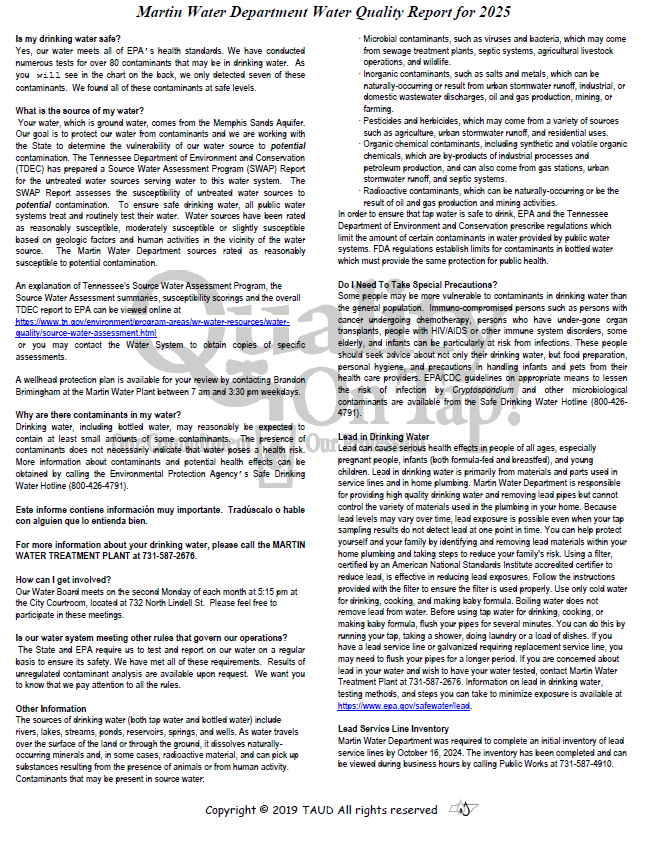
The City of Martin has released its 2025 Consumer Confidence Report, showing the city’s drinking water met all applicable federal health standards during the reporting period while providing residents with an overview of water quality testing and system operations.
The annual report, required under the federal Safe Drinking Water Act, details where Martin’s drinking water comes from, what contaminants were tested and whether any exceeded Environmental Protection Agency standards.
According to the report, Martin’s drinking water met all EPA health standards. The city tested for more than 80 potential contaminants and detected seven, all at levels considered safe under federal drinking water regulations.
Martin’s drinking water is supplied by groundwater from the Memphis Sand Aquifer. The report states the Tennessee Department of Environment and Conservation has completed a Source Water Assessment for the city’s water supply and classified the source as reasonably susceptible to potential contamination. The report notes that public water systems routinely treat and test water to ensure it remains safe for consumers.
Water quality data included in the report shows the city recorded no violations for total coliform bacteria, copper, fluoride, lead, sodium, combined radium, total trihalomethanes, haloacetic acids or chlorine during the reporting period. All detected contaminants remained below federal maximum allowable levels.
The report notes that one of the 100 homes sampled during the city’s most recent lead and copper testing exceeded the federal action level for lead. Federal regulations do not consider a single elevated sample to be a system violation. Instead, utilities must take corrective action if more than 10 percent of sampled homes exceed the action level. Martin’s 2023 sampling found one home above the action level while the remaining 99 samples were below the threshold.
The report also includes updated information on lead in drinking water, explaining that lead exposure typically comes from plumbing materials inside homes rather than the public water system itself. Residents are encouraged to use cold water for drinking and cooking, flush household plumbing before using water that has been sitting in pipes and consider certified water filters if they have concerns about lead exposure. Martin completed its required Lead Service Line Inventory in October 2024, and the inventory is available for public inspection through the city’s Public Works Department.
In addition to water quality testing, the report reminds residents that unused or expired medications should not be flushed down drains because pharmaceuticals can enter waterways. Information on medication disposal sites is available through the Tennessee Department of Environment and Conservation. The report also encourages residents to report suspicious activity around water treatment facilities or other utility infrastructure.
Unlike some Consumer Confidence Reports reviewed by the Weakley County Examiner this year, Martin’s report appears to be properly completed with current utility information, updated contact details and current testing data. The only noticeable formatting issue is the title on the first page, which reads “Water Quality Report for 200325,” appearing to combine an old template date with the current reporting year.
The Martin Water Board meets at 5:15 p.m. on the second Monday of each month in the City Courtroom, 732 N. Lindell St. Residents with questions about the city’s drinking water may contact the Martin Water Treatment Plant at 731-587-2676.
Make a one-time donation
Make a monthly donation
Make a yearly donation
Choose an amount
Or enter a custom amount
Your contribution is appreciated.
Your contribution is appreciated.
Your contribution is appreciated.
Leave a Reply